


Imagine you’re climbing out of a dark sewer and some beast has its teeth sunk into your leg, making a lot of noise, tearing at you, and weighing you down: a demon. Are you going to jump back down into the sewer and fight it? A lot of people think that’s the answer, but why do that?
It’s tough to slay demons because they’re symptoms, not causes, and even if you kill one, there are always more. What’s next, a fight to the death with your obsessive neatness? Pistols at dawn with your love of chocolate? The only real result of these little battles is that you haven’t gone anywhere: you’re still in the sewer. All you’ve really killed is time, and time is all you really have. You haven’t killed a demon; you’ve lost a piece of your life, and that means they’ve won: the part of you that’s afraid to move forward has won.
You have to ask yourself, what’s your objective? To achieve mental equilibrium in a sewer or to climb out of it? To slay every little demon or to rise up out of the realms they inhabit? Don’t laugh like it’s obvious; everyone seeks solutions within the sewer rather than escape from it.
Battling demons is the ultimate form of shadow boxing. You’re just punching at an empty projection of yourself. For our purposes, if demons aren’t demonizing you, then they don’t exist: it’s as simple as that. ― Jed Mckenna, Spiritual Warfare
The book “quote” in the image and the quote in the text seem to contradict each other. Now let’s stir in a seemingly unrelated (all things are connected) ingredient into today’s stew. Ponder Kurtz’s following insight, and think about this: If it’s possible to hold two competing thoughts alongside each other, why not three? This is the key to transcending “Cognitive Dissonance” and moving into a state of “Integrative Thinking”. I think we’ll call it Third Thing Logic.
Now we have moved beyond the Aristotelian, either/or state, and entered a new “third thing.” A more quantum state. A third mind?
Using a method from Hermetic practice, telesmata: ritually constructed, consecrated, and charged images visualized to achieve a specific purpose, is close to what I am describing. In ritual magick, one holds many properties in conjunction in their mind and experiences a new property emerging from their union.
Morrison, one of this project's patron saints, opined in an interview that music would evolve beyond rock, a combination of American blues and country, into a “third thing” he left undefined.
I propose a third-thing scenario for art in general, and we seek to recover the contents of the missing manuscript to guide our journey forward. This recovered material will be an early example of the “third-thing” art form. Later I will describe how I see Kurtz’s scenario as exemplified in Apocalypse Now, being congruent with Third Thing Logic.
Can you take this journey with me, up the river, kill the god, retrieve the manuscript, and journey back down the river as a new, reintegrated person? Not the same person who left? Essentially, a figurative, shamanic initiatory transformation. Hopefully warming you up, in preparation for the real thing.
Or will you be an errand boy, sent by grocery clerks to collect a bill?
A BEGINNER’S GUIDE TO C.G. JUNG’S RED BOOK

The old expression “When falling, dive!” might best express the sentiments of Carl Jung as he decided to turn a near psychotic breakdown he was experiencing in late 1913 into an opportunity for self-analysis and self-therapy. The result of this momentous decision is The Red Book, Jung’s record of his “confrontation with the unconscious,” which he had bound in a custom-made red leather folio that measured approximately 12 X 15.5 inches and weighed nearly ten pounds. Like a massive, medieval folio reminiscent of the Book of Kells, The Red Book included over 400 pages of beautifully handwritten, calligraphic text and 53 startlingly brilliant full-page paintings. Originally, when Jung began to be afflicted by an unceasing flood of apocalyptic visions in 1913, he started to record them in a series of six black journals (subsequently known as the “black books”) and later transferred them to the large red leather folio. By 1917, he had finished most of the initial composition of the book but poured over it until 1930, revising, adding commentary, editing (Furlotti).
Archive of my first Blog
Somebody brought up my first blog the other day and asked me if I remembered the year I had started it. I guessed 2003, but when I checked archive.org, I discovered it was actually 2002. I initially named it IncuBLOGula, but later changed it to StArE, deciding the name IncuBLOGula was too cute by one half.
Anyway, here’s the archive if you want to peruse the back issues.

LINK: https://web.archive.org/web/20030205074510/http://www.incunabula.org/blog/archive/index.html
Five Experimental Anti-Novels That Break the Form (Beautifully)
Dan Leach Recommends Michael Bible, Maggie Nelson, Haruki Murakami, and More

LINK: https://lithub.com/five-experimental-anti-novels-that-break-the-form-beautifully/
We tried speaking to dolphins – and they spoke back | Diana Reiss
When AI comes for your purpose in life

One of my favorite parts of this interview is hearing the guest describe the eccentric mathematicians in recent history. My kinda people.
One with the world? A new look at brains transformed by psychedelics.

For about a decade, the mainstream understanding has been that psychedelics cause chaos in the brain. Brain networks—the stable patterns of communication that handle vision, attention, or our sense of self, and more—loosen and start talking to each other all at once. EEG traces get noisier and more complex. “Think of the networks of the brain as highways,” says Devon Stoliker, a neuroscientist at Monash University. “Under psychedelics, these highways break down into many different directions.”
In a recent Nature study, Stoliker’s team designed an experiment to test whether these directions are truly chaotic and random. Researchers gathered 62 people who had never taken a psychedelic before, gave them 19 milligrams of psilocybin, a common psychedelic found in certain fungi, and scanned their brains. Then, they used AI to analyze the drugged and sober brain scans. What emerged was not exactly chaos.
Scientific Instruments: Real science you can hear. four instruments that turn DNA, orbits, harmonics and particles into sound, all tuned from real data and able to lock to a shared tempo with Grid Sync.
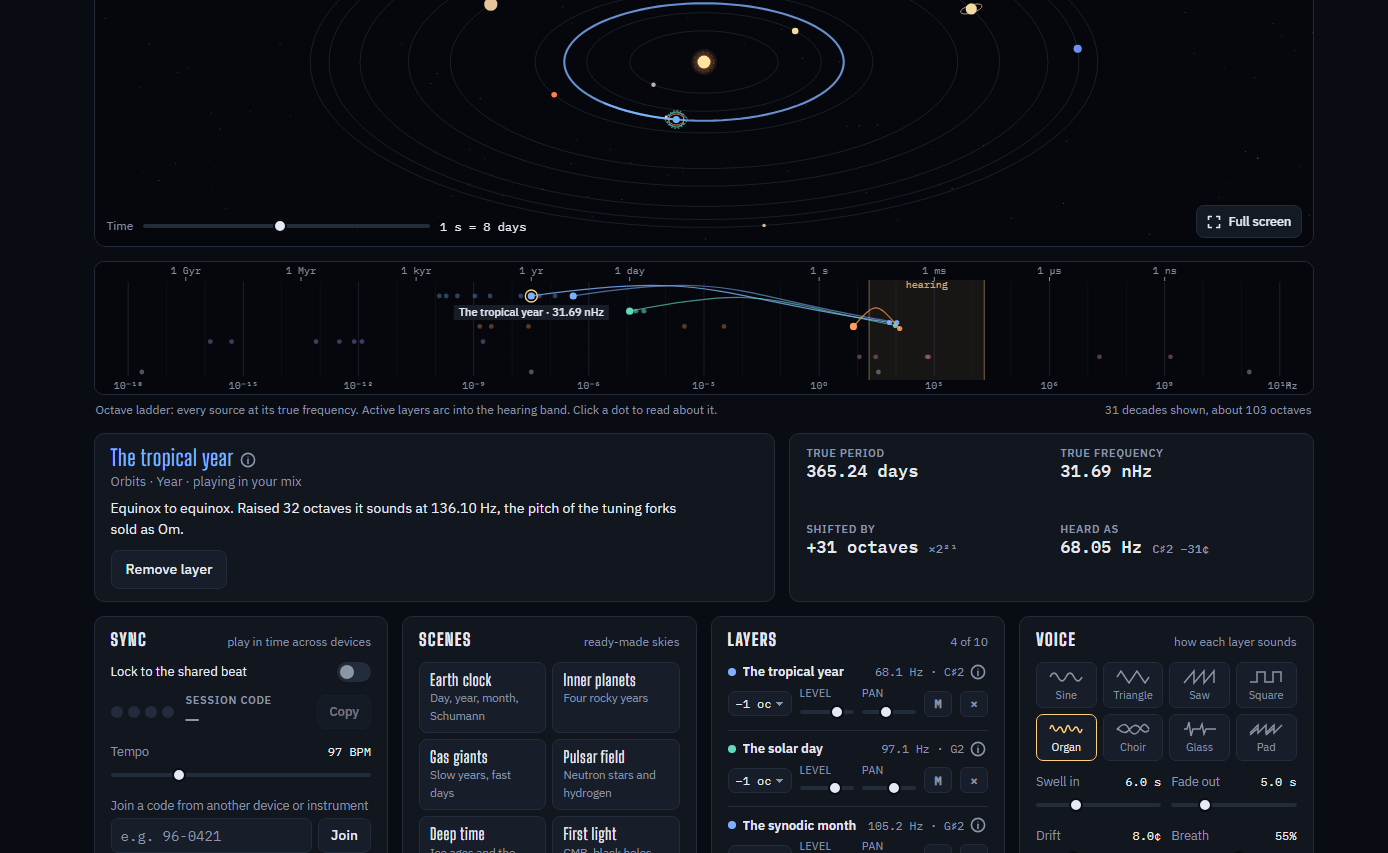
My old friend Jason Nunes is up to some useful and fun shenanigans. You might remember Jason as the illustrator of my book, Statio Numero. He’s a wildly talented artist. Check out his current madness.
Try it here: https://www.beardedtwin.com/scientific-instruments?trk=feed-detail_comments-list-reply_comment-text
New Dawn Special Issue Vol.20 No.5

There’s a segment in this issue about The Montauk Project, and its connection to Ong’s Hat. So now is a good time to clarify, AGAIN, the so-called connection between the two myths.
In 2002, I let Skybooks, a press specializing in the Montauk Project mythos, publish an edition of Ong’s Hat material. The publisher included a foreword and an afterword that looped Ong’s Hat into the Montauk conversation. When I saw it, I expressed dissatisfaction but agreed that I would let it go since the material was already printed.
Years ago, I asked the publisher how many copies, if any, were left and arranged to take that version off the market. I then rewrote the material, edited it, added new material, and removed material I did not want included. I then reissued the material on my own imprint as Ong’s Hat: The Beginning: Authorized Version, hence the designation "Authorized." It’s to differentiate the current edition from the former.
That said, I found the full article in New Dawn’s Special Edition interesting. New Dawn has always been polite and kind to me, so I want to be clear here. I am not unhappy with them or the writer. I'm actually intrigued by the material and its presentation. I wanted to share this material because it’s interesting and deserves consideration. I also want to use this as an opportunity to clarify the different editions of my book and the two distinct myths.
Anyway, I hope you enjoy New Dawn’s Special Edition. It’s very engaging, well written, and I think you might find it food for thought.

LINK TO BUY FULL EDITION: https://www.newdawnmagazine.com/product/new-dawn-special-issue-vol-20-no-5